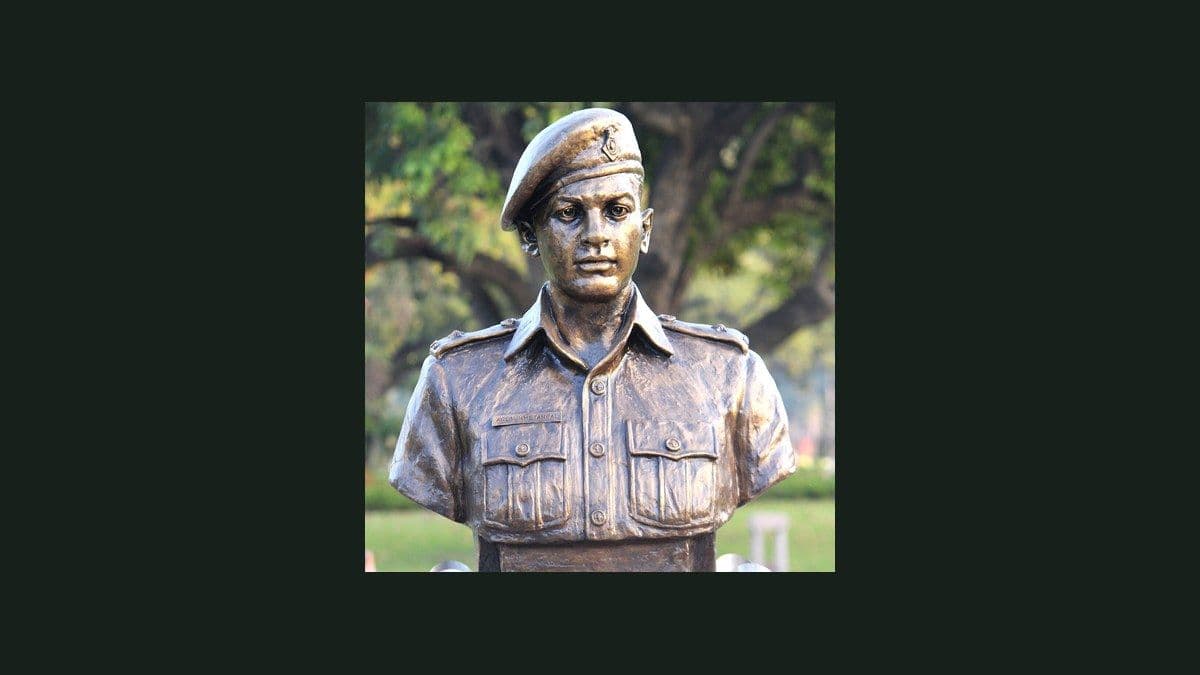
2/Lt Arun Khetarpal of 17 Horse stayed in his burning tank at Jarpal on 16 December 1971, kept firing on enemy armour and was killed by a second hit.
Reinforcing at Jarpal
On 16 December 1971, a Pakistani armoured regiment attacked the position at Jarpal in the Shakargarh sector, and the squadron commander asked for reinforcements. Second Lieutenant Arun Khetarpal of 17 Horse heard the call on the radio and moved his troop forward.
On the way, enemy strong points and recoilless gun nests in the Basantar bridgehead opened fire. Khetarpal assaulted and overran them, and one of his tank commanders was killed. He broke through to the squadron, then chased withdrawing enemy tanks and destroyed one.
Famagusta's Last Engagement
The enemy attacked again with an armoured squadron against three Indian tanks, one of them Khetarpal's. Ten enemy tanks were destroyed, four of them by him, according to the citation.
His tank was hit and caught fire, and he was severely wounded. Ordered to abandon it, he stayed and destroyed one more tank. A second hit killed him. The National War Memorial names his Centurion as Famagusta.
Six Months Commissioned
Khetarpal was born in Pune on 14 October 1950, the son of Brigadier M. L. Khetarpal. He attended Lawrence School, Sanawar, and the National Defence Academy, Khadakvasla, and was commissioned on 13 June 1971. He was 21 at Jarpal.
The citation
On the 16th December, 1971, when our position at Jarpal in the Shakargarh Sector was subjected to an attack by a Pakistani armoured regiment and our troops were heavily out numbered by enemy forces, the squadron commander asked for reinforcements. 2/Lt. Khetarpal on hearing this transmission over the radio answered the call and moved with his troops to meet the enemy attack. On the way, his troops came under fire from enemy strong points and Recoilless Gun nests that were still holding out in the bridgehead established across the Basantar river by our troops. Realising that a critical situation was developing and prompt action was to be taken, 2/Lt. Khetarpal assaulted the enemy strong points, physically over-running them and capturing the enemy's infantry and weapon crews at pistol point. In the course of this action, the Commander of one of the tanks in his troop was killed, but 2/Lt. Khetarpal continued to attack relentlessly till all opposition was overcome and he broke through towards the location of our Squadron. When the enemy tanks started pulling back after their initial probing attacks, he chased them and destroyed one of them. When the enemy launched another attack, with an armoured Squadron, against the sector held by three of our tonks, one of which was manned by 2/Lt. Khetarpal, a fierce battle ensued and 10 enemy tanks were hit and destroyed of which 2/Lt. Khetarpal personally destroyed four. In the fight 2/Lt. Khetarpal's tank was hit and it burst into flames and he was severely wounded. 2/Lt. Khetarpal was ordered to abandon his tank but realising that the enemy was still pressing their attack in this Sector and that if he abandoned his tank, there was given the task of establishing a bridgehead across the [sic: misprinted line in the Gazette] spite of grevious wounds and his own tank burning he continued engaging the enemy tanks and destroyed one more. At this stage, his tank was hit a second time as a result of which he died but the enemy was denied the break thorugh he was seeking so desparately.
In this action, 2/Lt. Arun Khetarpal displayed most conspicuous gallantry in the face of the enemy, indomitable fighting spirit and tenacity of purpose.
Source: Gazette of India. Reproduced as printed, including any errors in the original.
Cover image: Krishna Chaitanya Velaga, CC BY-SA 4.0, via Wikimedia Commons. Resized for this page. https://commons.wikimedia.org/wiki/File:Second_Lieutenant_Arun_Khetarpal_statue_at_Param_Yodha_Sthal_Delhi.jpg