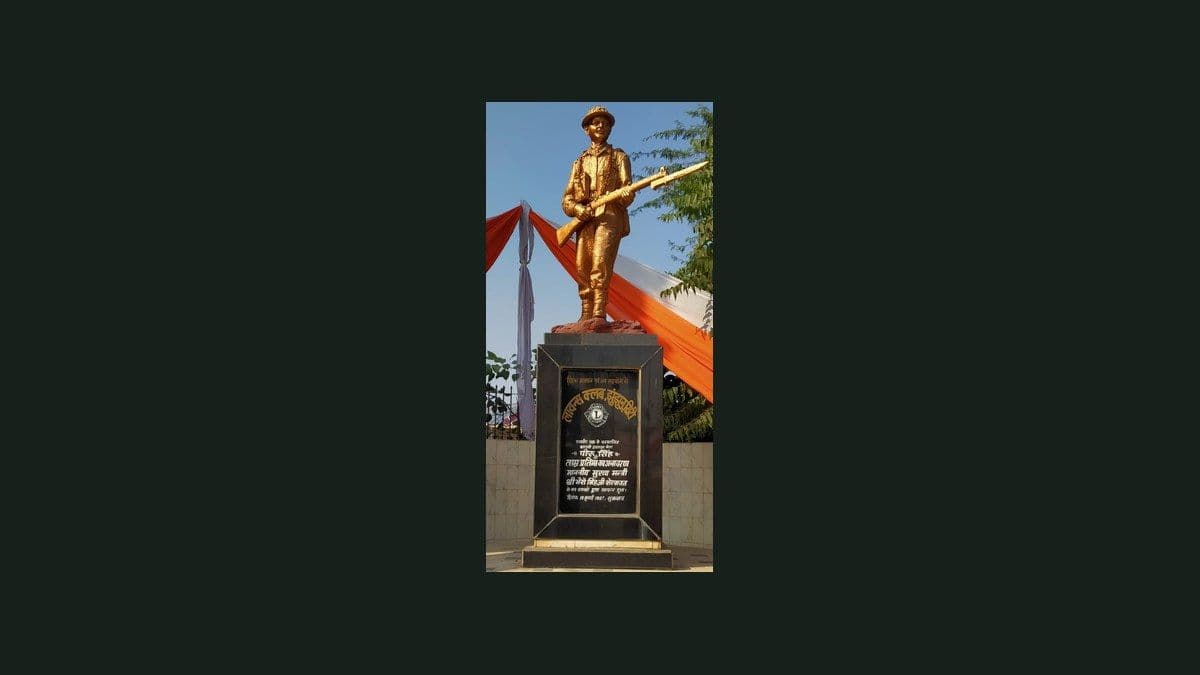
Company Havildar Major Piru Singh of 6 Rajputana Rifles attacked enemy positions alone south of Tithwal on 18 July 1948 and died of his wounds.
Hill feature south of Tithwal
D Company of 6 Rajputana Rifles was ordered to capture an enemy-held hill south of Tithwal on 18 July 1948. Medium machine guns covered every approach, and as the company advanced it took fire from both flanks and grenades from the bunkers above.
Company Havildar Major Piru Singh was with the leading section. More than half of it was soon killed or wounded. He went forward to the nearest machine-gun position, wounded by grenade splinters, and silenced the gun with his Sten gun and bayonet.
Three enemy positions
By then, the Gazette records, he was the sole survivor of the section, the rest dead or wounded. A further grenade wounded him in the face. He crawled out of the trench throwing grenades at the next position, and killed two men in the next trench with the bayonet. The commander of C Company, directing supporting fire, saw this.
A bullet hit him in the head as he left the second trench for the third bunker. He fell at the edge of the enemy trench, and an explosion followed inside it, which the Gazette attributes to his grenade.
Piru Singh, son of Lal Singh, came from Jhunjhunu in Rajasthan. His award was notified in the Gazette of India on 26 January 1952, as No. 8-Pres./52.
The citation
2831592 Coy. Hav, Major PIRU SINGH, 6 Bn, The Rajputana Rifles (Posthumous) (18th July, 1948).
South of TITHWAL D Company, of which No. 2831592 PIRU SINGH was Havildar Major, was detailed to attack and capture an enemy occupied hill feature. The enemy had well dug in positions and had sited his MMGs. so as to cover all possible approaches. As the attack advanced, it was met by heavy MMG fire from both flanks. Volleys of grenades were hurled down from enemy bunkers. CHM PIRU SINGH was then with the forward most Section of the Company.
Seeing more than half of the Section killed or wounded he did not lose courage. With battle cries he encouraged the remaining men and rushed forward with great determination on to the nearest enemy MMG position. Grenade splinters ripping his clothes and wounding him at several places, he continued to advance without the least regard to his safety. He was on top of the MMG position wounding the gun crew with sten gun fire. With complete disregard to his bleeding wounds he made a mad jump on the MMG crew bayonetting them to death, thus silencing the gun.
By then he suddenly realised that he was the sole survivor of the section, the rest of them either dead or wounded. Another grenade thrown at him wounded him in the face. With blood dropping from his face wounds into his eyes, he crawled out of the trench, hurling grenades at the next enemy position.
With a loud battle cry, he jumped on the occupants of the next trench, bayonetting two to death. This action was witnessed by the 'C' Company Commander who was directing fire in support of the attacking Company.
As Hav Major PIRU SINGH emerged out of the 2nd trench to charge on the 3rd enemy bunker, he was hit in the head by a bullet and was seen dropping on the edge of the enemy trench. There was an explosion in the trench which showed that his grenade had done its work. By then CHM PIRU SINGH's wounds had proved fatal.
He had paid with his life for his singularly brave act, but he had left for the rest of his comrades an unique example of single handed bravery and determined cold courage.
Source: Gazette of India. Reproduced as printed, including any errors in the original.
Cover image: Amzadkhankk, own work, CC BY-SA 4.0, via Wikimedia Commons. Resized for this page. https://commons.wikimedia.org/wiki/File:Piru_Singh_PVC_copper_statue.jpg