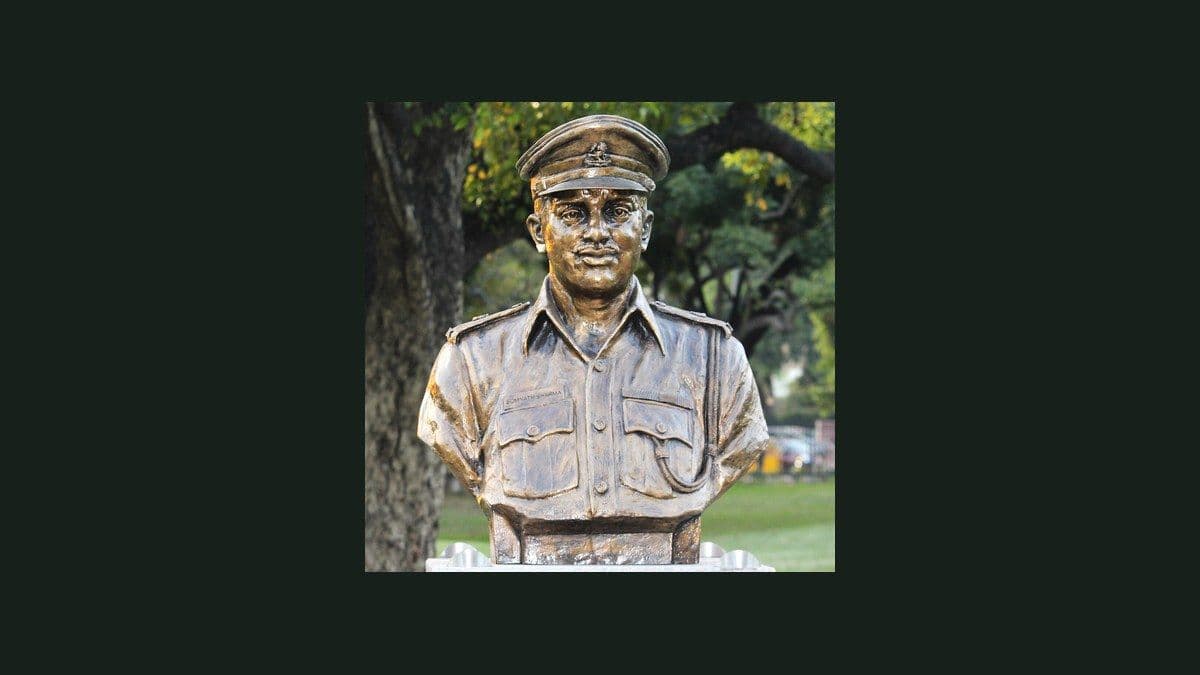
Major Somnath Sharma of 4 Kumaon held Badgam against an attack on three sides on 3 November 1947, and was the first Param Vir Chakra recipient.
Fighting patrol to Badgam
On 3 November 1947, Major Somnath Sharma's company of 4 Kumaon was ordered on a fighting patrol to Badgam in the Kashmir Valley. The village lay less than two miles from the Srinagar airfields, and a raider column was reported to be heading for it.
Sharma's left hand was in plaster after a fracture suffered playing hockey. He had been advised to rest, but asked to stay with his company and was allowed to command it.
The Ministry of Defence profile puts the attack at 1430 hours. The citation estimates the enemy at 500, coming from three sides. Sharma crossed open ground under fire to reach his sections, directed their fire, and laid out cloth strips to guide aircraft onto the target.
When casualties reduced his light automatics, he began filling magazines and passing them to the light machine gunners. A mortar shell landed in the ammunition, and the explosion killed him.
Six hours gained for Humhama
His company held on and withdrew only when almost surrounded. The delay of six hours gave reinforcements time to take up position at Humhama, on the route to Srinagar.
Sharma, one junior commissioned officer and 20 other soldiers of D Company were killed. The profile records raider losses of over 200.
He was born on 31 January 1923 at Dadh in Kangra, the son of Major General Amar Nath Sharma, and was the first recipient of the Param Vir Chakra.
The citation
On 03 Nov 1947, Major Somnath Sharma's company was ordered on a fighting patrol to Badgam in the Kashmir Valley. He reached his objective at first light on 03 Nov and took up a position south of Badgam at 1100 hours. The enemy, estimated at 500, attacked his company position with three sides, the company began to sustain heavy casualties.
Fully realizing the gravity of the situation and the direct threat that would result to both the aerodrome and Srinagar if the enemy attack was not held until reinforcements could be rushed to close the gap leading to Srinagar via Humhama, Major Sharma urged his company to fight the enemy tenaciously. With extreme bravery, he kept rushing across the open ground to his sections exposing himself to heavy and accurate fire to urge them to hold on. Keeping his nerve, he skillfully directed the fire of his section into the ever-advancing enemy. He repeatedly exposed himself to the full fury of enemy fire and laid out cloth strips to guide our aircraft onto their target in full view of the enemy.
Realising that casualties had affected the effectiveness of his light automatics, this officer, whose left hand was in plaster, personally commenced filling magazines and issuing them to light machine gunners. A mortar shell landing right in the middle of the ammunition resulted in an explosion that killed him.
Major Sharma's company held onto its position and the remnants withdrew only when almost completely surrounded. His inspiring example resulted in the enemy being delayed for six hours. Thus, gaining time for our reinforcements to get into position at Humhama to stem the tide of the enemy advance. His leadership, gallantry and tenacious defence were such that his men were inspired to fight the enemy by seven to one for six hours, one hour which was after this gallant officer had been killed.
He has set an example of courage and qualities seldom equaled in the history of the Indian Army.
Source: Ministry of Defence gallantry awards record. Reproduced as printed, including any errors in the original.
Cover image: Krishna Chaitanya Velaga (KCVelaga), own work, CC BY-SA 4.0, via Wikimedia Commons. Resized for this page. https://commons.wikimedia.org/wiki/File:Major_Somnath_Sharma_statue_at_Param_Yodha_Sthal_Delhi.jpg