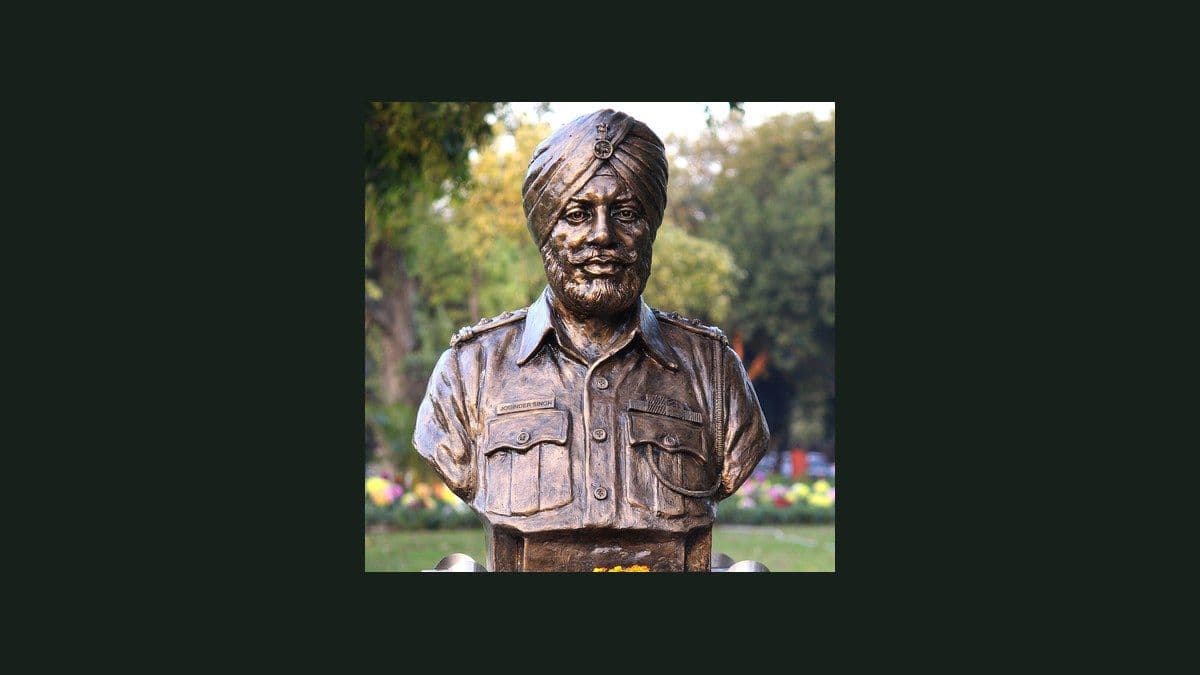
Subedar Joginder Singh of 1 Sikh held a position at Bum La against repeated Chinese attacks on 23 October 1962 and received a posthumous Param Vir Chakra.
Third Attack at Bum La
By the third Chinese attack at Bum La on 23 October 1962, Subedar Joginder Singh's platoon of 1 Sikh had lost half its men. It had already repulsed two attacks, the National War Memorial records, and the enemy had taken heavy losses.
Joginder Singh had been wounded in the thigh and had refused evacuation. When the position came under attack again, he took over a light machine gun and fired on the attackers himself.
Then the ammunition ran out. He led his men into a bayonet fight against a far larger force.
Two Official Accounts of His Death
Government records differ on how he died. The National War Memorial says he was killed in that fight. A profile on the Ministry of Defence gallantry awards portal says he was wounded and captured, and died of his injuries in Chinese custody.
Mahla Kalan to 1 Sikh
The portal gives his home as Village Mahla Kalan, Moga, in Punjab, and names his parents as Sher Singh and Kishan Kaur. He joined the British Indian Army in 1936 and served with the 1st Battalion of the Sikh Regiment.
His service number was JC-4547. The Param Vir Chakra was awarded posthumously.
What the citation recorded
Summary, not the official wording. The award recognised Subedar Joginder Singh's command of a platoon of 1 Sikh at Bum La on 23 October 1962. The platoon drove back two Chinese attacks and lost half its strength. He was wounded in the thigh and declined evacuation. When a third attack came he used a light machine gun himself, and when the ammunition was gone he led his men in a bayonet fight against a much larger force. The National War Memorial's account, on which this summary is based, cites his gallantry and leadership.
Cover image: Krishna Chaitanya Velaga, CC BY-SA 4.0, via Wikimedia Commons. Resized for this page. https://commons.wikimedia.org/wiki/File:Subedar_Joginder_Singh_statue_at_Param_Yodha_Sthal_Delhi.jpg