The Air Force in Kashmir, 1947 to 1948
How the Dakotas of No. 12 Squadron, RIAF, carried troops to Srinagar in October 1947 and opened landing grounds at Poonch and Leh.
Vetnet Editorial
4 min read
At a glance
- First landing at Srinagar
- 27 October 1947, Wg Cdr K.L. Bhatia, Dakota VP 905
- Sorties on day one
- 28 Dakota sorties, 6 of them civil
- Squadron
- No. 12 Squadron, RIAF (10 Dakotas)
- First Dakota at Poonch
- 12 December 1947, Fg Offr Des Pushong, VP 903
- Leh landing
- 24 May 1948, Air Cmde Mehar Singh, at 11,554 feet
- Mehar Singh's award
- Maha Vir Chakra, 26 January 1950
- Airlift to Srinagar
- All of 161 Infantry Brigade flown in within five days
- Poonch
- About 10,000 residents and 35,000 refugees supplied by air
Srinagar, 27 October 1947
Wing Commander K.L. Bhatia made the first landing at Srinagar on 27 October 1947, in Dakota VP 905 of No. 12 Squadron, Royal Indian Air Force. Three squadron Dakotas flew that first lift. By nightfall 28 Dakota sorties had been flown, six of them civil.
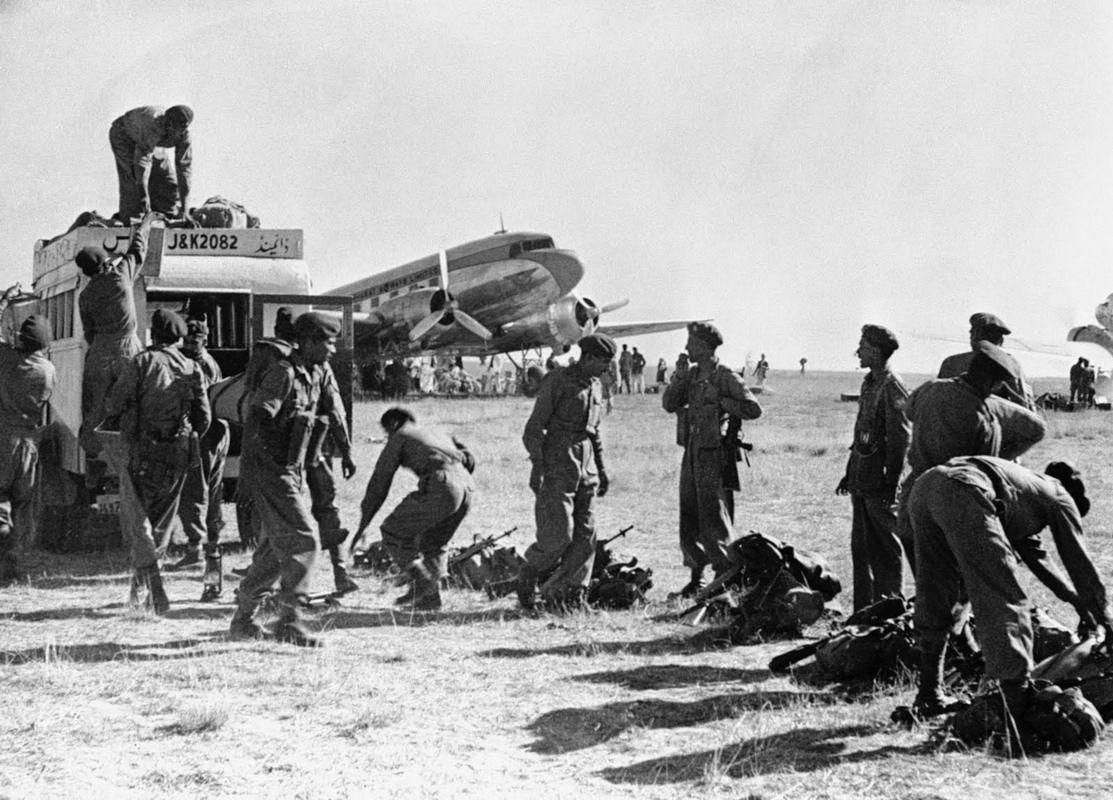
No. 12 was the only transport squadron in the service at Independence, and it had ten aircraft. The operational order for 1 Sikh allowed each RIAF Dakota 17 men and 500 lb, and each civil Dakota 15 men and 500 lb.
The landing was unopposed. Losses came quickly all the same. On 31 October Dakota MA 965, under Flight Lieutenant C.J. Mendoza, went missing with crew and passengers. The wreckage was not found for many months. RIAF Tempests supported 161 Brigade at Shalateng on 7 November, when the raider column was routed.
A transport squadron barely formed
No. 12 Squadron had been formed at Kohat on 1 December 1945 as a Spitfire squadron. It converted to the Airspeed Oxford at Bhopal and was meant to go on to the Mosquito light bomber. That plan was dropped, and it became the Royal Indian Air Force's first transport squadron, flying Dakotas, with pilots drawn from the fighter squadrons.
Training was still under way at Partition. Air Marshal L.S. Grewal, then a Flying Officer in the squadron, recalled that it had six aircraft and about half a dozen fully trained pilots with 30 to 40 hours each on the Dakota, while pilots like him had 15 to 20 hours, all by day. Shivdev Singh was commanding the squadron in late August 1947. On the afternoon of 26 October the crews were ordered to Delhi with four Dakotas and briefed to fly a company of 1 Sikh to Srinagar.
Over the next five days No. 12 Squadron and the requisitioned civil Dakotas shuttled between Delhi and Srinagar and flew in the whole of 161 Infantry Brigade. The commanding officer of 1 Sikh, Lt Col Dewan Ranjit Rai, pushed his battalion on towards Baramula instead of holding the airfield, and was killed the next day. On 9 November Prime Minister Nehru visited Srinagar in an IAF Dakota, and Mehar Singh flew Maharaja Hari Singh in from Jammu.
Poonch by day and by night
Poonch was cut off, and the only way in was by air. Refugees took six days to finish a landing strip, on ground about 600 yards long, under mortar fire. Air Commodore Mehar Singh, commanding No. 1 Operational Group, flew in a Harvard and then a Dakota, and his citation calls him the first pilot to land there. The logbook of Flying Officer Desmond Pushong, however, records his own Harvard flight into Poonch on 10 December. Pushong brought in Dakota VP 903 on 12 December 1947 with Flying Officers Menon and Roy and Warrant Officer Nanu.
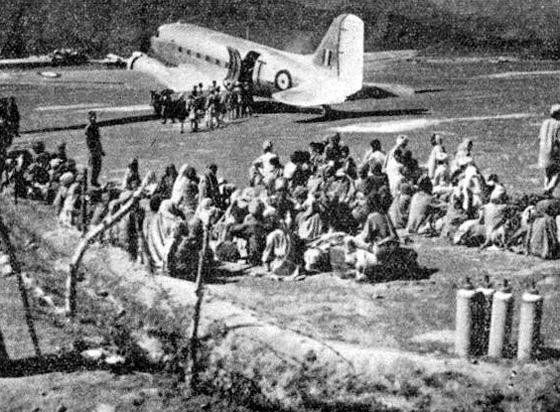
Enemy guns soon had the strip bracketed. Dakotas flown by Pushong and Lal Singh Grewal then carried in 3.7-inch howitzers of the 4th (Hazara) Mountain Battery by moonlight, landing without lights.
On 21 March 1948 an attempt to deliver 25-pounder guns failed when Bhatia's Dakota was hit as it landed. That night four Dakotas landed at Poonch, with Mehar Singh in the first.
Bombs from a cargo door
Poonch held about 10,000 local people and 35,000 refugees besides its garrison, and Brigadier Pritam Singh organised hundreds of refugees to build the airstrip. Tempest fighter-bombers and Harvards based at Jammu attacked the raiders around the town. On 4 December Tempests fired 20 mm cannon at positions north-east and north-west of Poonch, and on 7 December positions close to the town were attacked with rockets and strafed.
To avoid the Tempests, the raiders moved their convoys by night. Grewal recalled that Mehar Singh's answer was to load a bomb into a Dakota's cargo hold, fuse it by torchlight and roll it out of the door. A timeline drawn mostly from Wing Commander Bhatia's logbook records such sorties. On 17 March 1948 Dakota VP 914 dropped six 250 lb bombs over Poonch at night, and on 23 March VP 912, with Air Vice Marshal Subroto Mukerjee aboard, dropped twelve. On 19 August 1948 Flight Lieutenants Ghadiok and Grewal flew a bombing sortie over Murree and dropped 12 bombs.
Wing Commander J.D. Acquino took command of the squadron in April 1948. On 19 June Flying Officer D. Barty landed a Dakota on a small strip at Poonch to evacuate casualties.
Leh at 11,554 feet
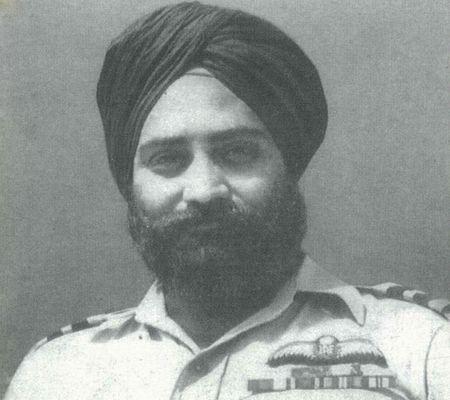
On 24 May 1948 Mehar Singh landed a No. 12 Squadron Dakota at Leh, at 11,554 feet. Major General Thimayya was among the passengers. Mehar Singh's Maha Vir Chakra, dated 26 January 1950, records that he was the first pilot to land at both Poonch and Leh.
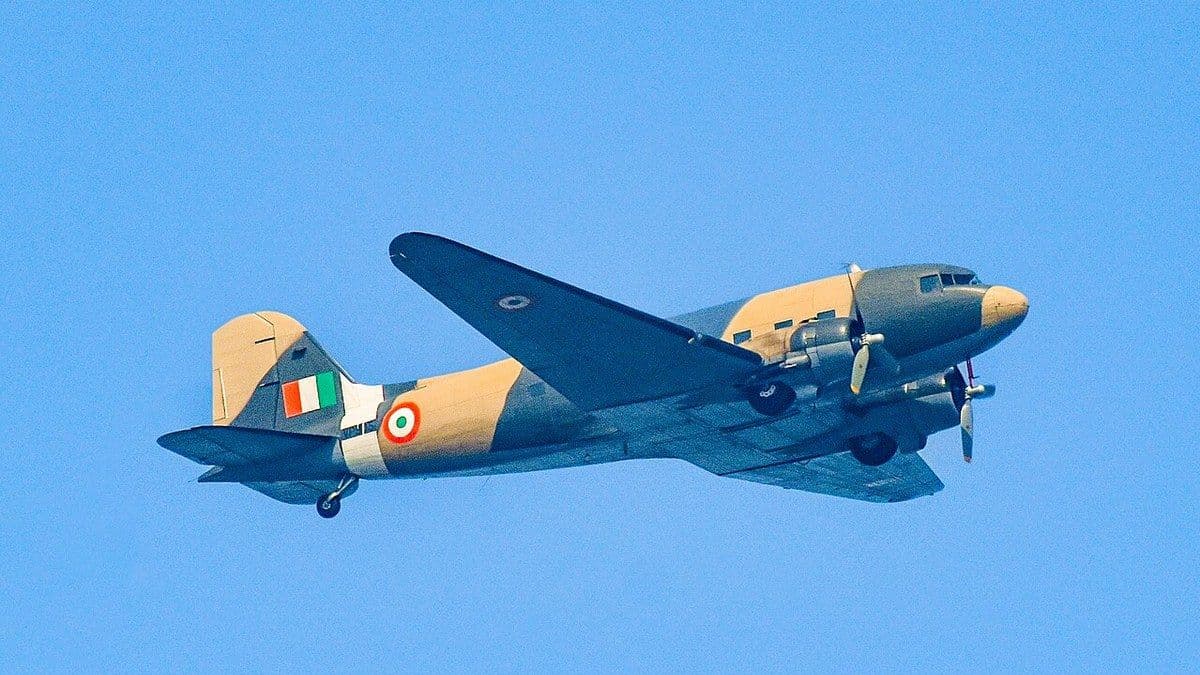
Cover image: Naman Vishwajeet, CC BY-SA 4.0, via Wikimedia Commons. Resized for this page. https://commons.wikimedia.org/wiki/File:A_Douglas_C-47_Skytrain_(Dakota)_of_the_Indian_Air_Force.jpg
- Indian Air Force
- Jammu and Kashmir 1947-48
Sources
- The Dakotas of No. 12 Squadron in Kashmir, 1947-48 · Bharat Rakshak
- Operation Poonching · Bharat Rakshak
- Air Commodore Mehar Singh, service record 1559 GD(P) · Bharat Rakshak
- Legend of IAF: IAF pilot who helped save Jammu and Kashmir after Independence · Centre for Air Power Studies