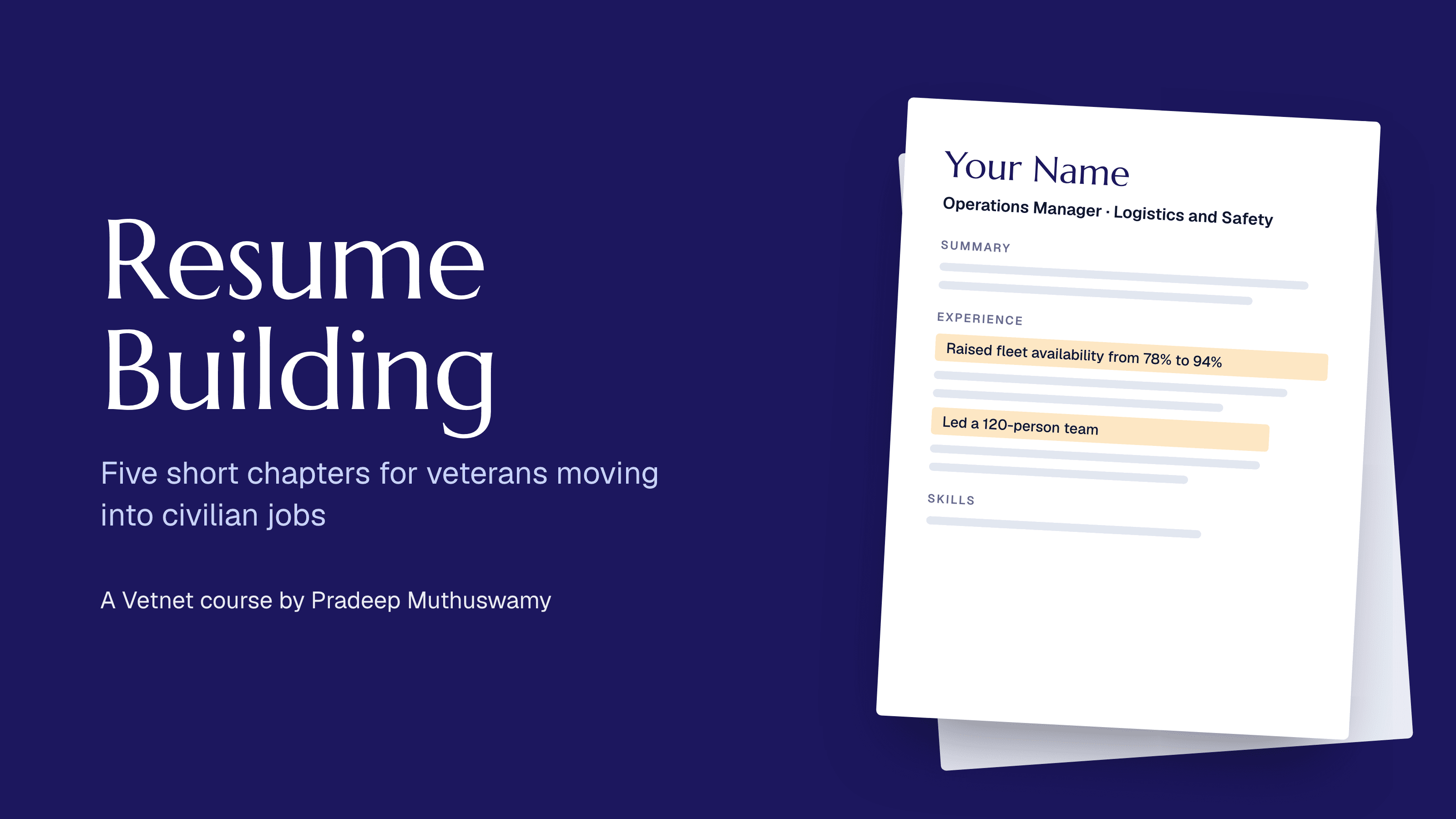
About this course
A practical course for veterans and ex-servicemen moving into civilian jobs. Start with a short introduction, then work through seven chapters: how recruiters read a resume, putting your service into civilian words, writing bullets that show results, structuring your resume so software and people can read it, tailoring and sending it, how applicant tracking systems (ATS) really work, and using AI assistants safely. A conclusion gives you a 30-day action plan. Each chapter comes with a slide deck and a printable worksheet. Mark each chapter complete as you go; finish them all to get a certificate you can download, verify and add to LinkedIn. By the end you'll have a complete one-page resume, ready to tailor to any job.
Course content
9 chapters · 10 videos
Enrol to watch the videos and open the documents. Chapter outlines are open to everyone.
Start here. Who this course is for, what you will have at the end (a complete one-page resume, tailored to a real job), how each chapter works, and what to gather before Chapter 1. Open the slides, then fill in the Before you start checklist.
How a resume is screened, from the applicant tracking system (ATS) to a recruiter's first look of about 7 seconds, and the format and length that work best when you move out of service. Open the slides first, then fill in the worksheet.
Rank and unit names don't tell a civilian recruiter what you did. Learn a 4-step method to put your duties into the words job posts use, and to show scale: people, money, equipment and area. Open the slides first, then build your own translation table.
Turn duties into results a recruiter remembers. Learn the bullet formula (action, what, scale, result), five ways to put a number on your work even without records, a verb bank, and an editing pass. Open the slides first, then rewrite 5 duties on the worksheet.
Put the right sections in the right order, in a layout both people and software can read. Covers the header (what to keep and leave out), a 3-line summary, core skills, ATS-safe formatting, and civilian certifications worth a look. Open the slides first, then draft your header, summary and skills with the guide.
Fit the resume to each job, check it, and send it well. Learn to tailor a resume in 15 minutes by mirroring the job post, run a final checklist, name the file, write a short cover note, and keep your Vetnet and LinkedIn profiles in line. Finish with the one-page resume template.
What an applicant tracking system (ATS) really does with your resume: parse, store, search, knock-out questions and recruiter review. Four worked examples show a clean parse and a broken one, keyword matching, a knock-out question and how a recruiter searches. Open the slides, then run the ATS self-test on your own resume.
Use ChatGPT, Gemini or Claude safely, honestly and well. What never to paste (operational details, service numbers, Aadhaar, contacts), how to check everything it writes, a 5-step way to work, and copy-ready prompts for translating duties, writing impact bullets, tailoring, a keyword check and trimming to one page. Open the slides, then use the prompt pack.
A one-line recap of every chapter, a week-by-week 30-day action plan, how to keep improving your resume, how to download, verify and share your certificate, and your next steps on Vetnet. Mark this chapter complete to finish the course and get your certificate.
Reviews
No reviews yetNo reviews yet. Learners who enrol can leave one.