Second Lieutenant Polur Muthuswamy Raman, Ashoka Chakra
2/Lt P. M. Raman of 3 Sikh Light Infantry led a pre-dawn assault at Chephema, Nagaland, on 3 June 1956 and died of his wounds, aged 21.
Vetnet Editorial
3 min read
At a glance
- Award
- Ashoka Chakra (posthumous), Republic Day 1957
- Unit
- 3rd Battalion, The Sikh Light Infantry
- Service number
- IC-7415
- Date of action
- 3 June 1956
- Place
- Chephema village, Naga Hills (now Nagaland)
- Born
- 4 December 1934
Fog at Chephema
Word reached 3 Sikh Light Infantry on 2 June 1956 that Naga insurgents were in Chephema village, Nagaland. Second Lieutenant Polur Muthuswamy Raman led the assault team, which reached the area at about 5 a.m. the next morning in fog and darkness.
The insurgents opened fire when challenged. Raman saw movement in a hut and killed two men. A grenade thrown at him missed. A second wounded him, and he kept going, chasing those who ran.
A man hiding nearby then shot him, severely wounding him. He threw a grenade that killed another insurgent and directed his men's fire until he lost consciousness. He died of his injuries that day. The hideout was destroyed.
The attack as Bravest of the Brave tells it
Kittu Reddy's Bravest of the Brave, a collection of profiles of Indian Army gallantry award winners, gives a fuller account of the morning. It says A Company of 3 Sikh Light Infantry was ordered to attack Chephema, which it spells Chephena, at dawn on 3 June 1956. Raman commanded No. 2 Platoon, which was to assault and clear the village.
As he entered the village, the hostiles opened fire with light machine guns, sten guns and rifles. Thick mist hid both sides and held up his platoon. When the mist broke for a moment, he saw movement near a hut, rushed it and killed two men with the first burst of his sten gun, then a third with the next. A grenade thrown at him missed. A second burst barely a yard away, tore his hat and wounded him. He pressed on, killed another man and cleared the position.
A hostile then fired a sten gun burst at him from point-blank range and wounded him in the groin. In this account the grenade Raman threw back wounded his attacker, who was seen dragging himself into a bush, rather than killing him. As the mist lifted, Raman called on his platoon to push forward and clear the village. The book credits the clearing of the prepared position to his action, which cost him his life.
Commissioned a Year Earlier
Raman was born on 4 December 1934. Sources disagree on where: Cannanore in one, North Arcot district in another. He was the son of Major Muthuswamy of the Army Medical Corps and the second of seven children, schooled partly in Burma and then in Pune.
Selected for the National Defence Academy, he was commissioned in 1955 into the Sikh Light Infantry, service number IC-7415. His first posting was the North-East Frontier Agency. His name is also spelled Pollur Mutthuswamy.
The portal lists his posthumous award in the Republic Day list of 1957.
Burma, Pune and Gaya
The same book names his mother as Savitri Muthuswamy and describes his father as an emergency-commissioned officer of the Army Medical Corps. The couple had five daughters and two sons, and Raman was the elder son. It gives his birthplace as Cannanore.
After early schooling in Burma he moved to Pune, where he passed his Secondary School Certificate examination from Saraswathi Vidyalaya High School, Rasthapet, in March 1950. His headmaster, R. V. Sastry, remembered him as "an extraordinarily well behaved boy". He then joined Wadia College, Pune, in the science stream, and had finished his first year when he was selected for the National Defence Academy.
After his commission into the Sikh Light Infantry in 1955 he was posted at Gaya, and then moved with his unit to the North-East Frontier Agency.
What the citation recorded
The official citation could not be read for this article. The Defence Ministry's portal leaves the citation field blank in the archived record. Secondary profiles describe his leading an assault at Chephema on 3 June 1956 and continuing to direct fire after being severely wounded. This is a summary, not the official wording.
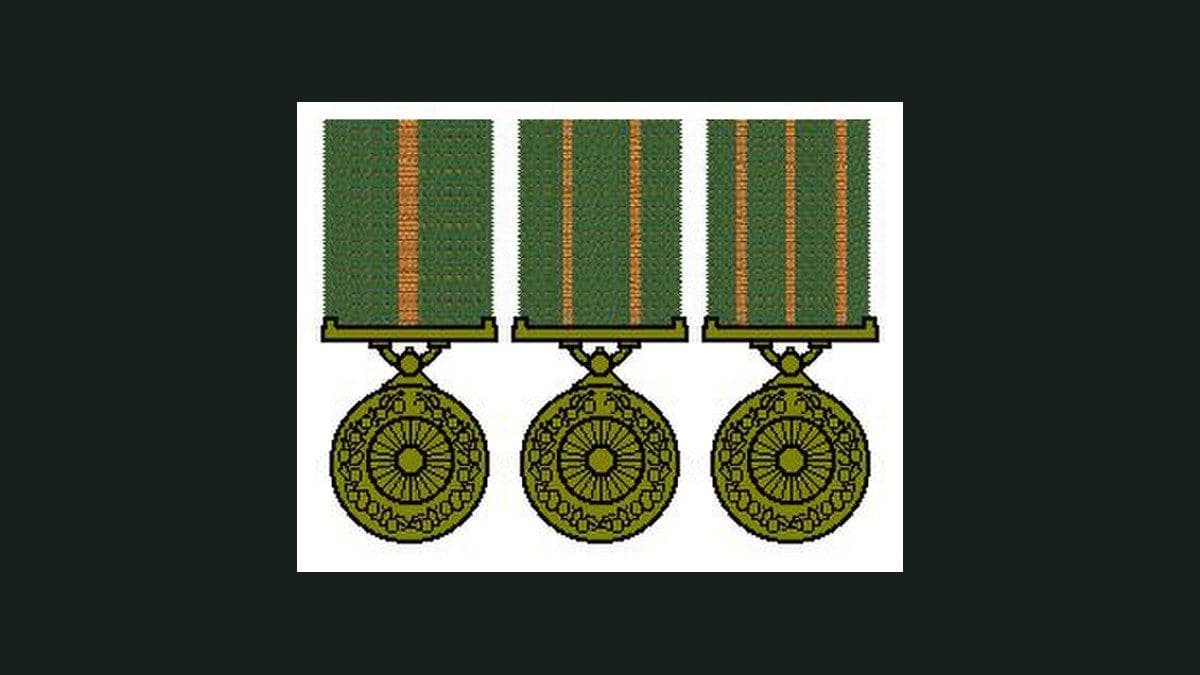
Cover image: Robert Prummel, CC BY-SA 3.0, via Wikimedia Commons. Resized for this page. https://commons.wikimedia.org/wiki/File:Ashoka_Chakra_India_De_drie_medailles_van_voor_1967.jpg
- Indian Army
- Ashoka Chakra
- 3 Sikh Light Infantry
Sources
- 2/Lt Polur Muthuswamy Raman, Ashoka Chakra (awardee record) · Gallantry Awards portal, Ministry of Defence (Internet Archive copy)
- Bravest of the Brave: Heroes of the Indian Army (2nd Lieutenant PM Raman, pp. 69-71) · Kittu Reddy, Ocean Books, New Delhi; digitised by the Digital Library of India on Internet Archive
- Pollur Mutthuswamy Raman · Wikipedia