Captain Man Bahadur Rai, Ashoka Chakra
Capt Man Bahadur Rai, MC, IDSM, scaled a ravine under close fire with half a platoon to take a fortified position in Nagaland on 3 May 1961.
Vetnet Editorial
3 min read
At a glance
- Award
- Ashoka Chakra, Class I, Gazette notification 9-Pres/62, with effect from 3 May 1961
- Earlier awards
- Indian Distinguished Service Medal (gazetted 17 February 1944); Military Cross
- Date of action
- 3 May 1961, Nagaland
- Units
- 1/10 Gurkha Rifles; 11 Gorkha Rifles; seconded to Assam Rifles
- Born
- 10 January 1914, Darjeeling district
- Died
- 14 February 2011, Jorhat, Assam
- Memorial
- Auditorium named after him at the Assam Rifles garrison, Laitkor, Shillong
Up the Side of the Ravine
The position on the slopes of a Nagaland ravine could be approached only from the front, and Captain Man Bahadur Rai judged that a frontal attack would cost many lives. On 3 May 1961 he took half a platoon instead, crawled through thick undergrowth and climbed the steep side under close-range fire.
Once he had located the position he went straight at it. He threw two hand grenades, then charged, firing as he went. His men followed and the defenders fled into the jungle, losing ten men in the encounter.
Days earlier, at the end of April, he had led a platoon through two hostile positions at dead of night and into the stronghold, driving out those holding it.
From Burma to Nagaland
Rai was born on 10 January 1914 in Darjeeling district and enlisted on 17 July 1930 in the 1st Battalion, 10th Gurkha Rifles. In the Burma campaign he won the Indian Distinguished Service Medal for action on 14 November 1943, and then the Military Cross.
He joined the re-raised 11th Gorkha Rifles after Independence and was seconded to the Assam Rifles from 1956. His Ashoka Chakra, notified in January 1962 with effect from 3 May 1961, was not posthumous.
He died at Jorhat, Assam, on 14 February 2011, aged 97.
How the Assam Rifles remember him
Rai's service in Nagaland was with the Assam Rifles. Wikipedia's record of his career has him seconded to the 8th Battalion on 20 November 1956, then posted to the Village Guards in the Naga Hills and Tuensang Area, and appointed Officer Commanding, Village Guard (Tuensang Wing), on 1 March 1958. The citation says he fought the 1961 actions first as an officer of 8 Assam Rifles and then of the Village Guards Organisation.
When he died in February 2011, PTI reported from Shillong that he was the oldest surviving recipient of the Ashoka Chakra, and described him as a retired Lieutenant Colonel. An Assam Rifles spokesman recalled the night advance through two hostile positions. He was laid to rest with full military honours, and a wreath was laid on behalf of the Director General of the Assam Rifles. The auditorium in the Assam Rifles garrison at Laitkor, Shillong, is named after him.
What the citation recorded
The official citation was not read at source; this summary follows a transcription of Gazette notification 9-Pres/62 on a secondary site. It recorded a series of actions in April and May 1961 against an entrenched Naga force in wooded, ravine-cut hills: a night advance by platoon through two positions into the stronghold, and on 3 May 1961 a climb up a steep flank under close fire with half a platoon, followed by a grenade attack and a charge that broke the position. This is a summary, not the official wording.
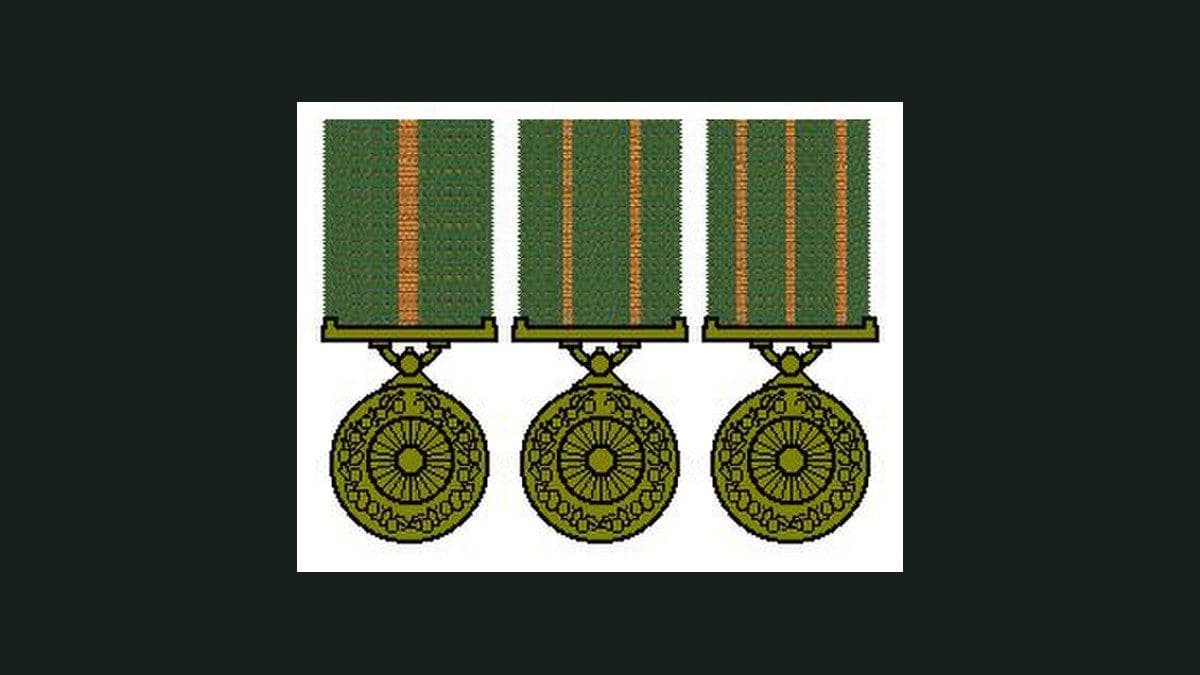
Cover image: Robert Prummel, CC BY-SA 3.0, via Wikimedia Commons. Resized for this page. https://commons.wikimedia.org/wiki/File:Ashoka_Chakra_India_De_drie_medailles_van_voor_1967.jpg
Ashoka Chakra, Class I
When his award was notified in 1962 the decoration was still graded in three classes, and the transcribed notification 9-Pres/62 awards him the Ashoka Chakra, Class I. The three classes had been instituted by President's Secretariat Notification No. 1-Pres./52 of 4 January 1952.
On 27 January 1967 the President's Secretariat renamed them. Class I became the Ashok Chakra, Class II the Kirti Chakra and Class III the Shaurya Chakra, which is the order of precedence still used for India's peacetime gallantry awards. The 1967 notification describes the Ashok Chakra as a circular gold-gilt medal, one and three-eighth inches across, with Ashoka's Chakra embossed at the centre inside a lotus wreath. It is awarded for most conspicuous bravery, or some act of daring or pre-eminent valour or self-sacrifice, otherwise than in the face of the enemy.
An image of the 1967 notification was shown by the National Archives of India in an exhibition in New Delhi in October 2025.
- Indian Army
- Ashoka Chakra
- 11 Gorkha Rifles
- Assam Rifles
Sources
- Supplement to The London Gazette, issue 36382, p. 827 (17 February 1944): IDSM, Subadar Manbahadur Rai, 10th Gurkha Rifles · The London Gazette
- Supplement to The London Gazette, issue 37151, p. 3382 (28 June 1945): Subadar Manbahadur Rai, I.D.S.M., 10th Gurkha Rifles · The London Gazette
- Man Bahadur Rai · Wikipedia
- Ashok Chakra awardee passes away (PTI) · Oneindia
- Ashok Chakra series gallantry awards were rechristened in 1967: Archival records (PTI) · ThePrint